
Pelvic Floor Training (Women)
Click here if you'd like a simpler print at home version
What are the Pelvic Floor Muscles?
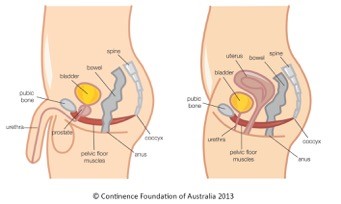
The pelvic floor muscles are the layer of muscles stretching from the pubic bone at the front, to the tailbone at the back. They form the floor of the pelvis.
The pelvic floor muscles help:
- Support the bladder, bowel and uterus (womb).
- Close off the bladder and bowel outlets to help prevent leakage
- Control problems such as frequency and urgency
- Empty the bladder and bowel
- Aid sexual response and orgasm
- Contribute to core stability
Factors contributing to pelvic floor muscle weakness:
- Pregnancy
- Childbirth
- Constipation or straining to empty bladder or bowel
- Heavy lifting
- Chronic coughing (e.g. from smoking, bronchitis or asthma)
- Being overweight
- Lack of general fitness
- Menopause
- Age-related changes
- Disuse (not doing pelvic floor exercises)
How to work your Pelvic Floor Muscles
The first step is to correctly identify the muscles:
- Sit in an upright chair with your back supported
- Relax your thighs, buttocks and tummy muscles
- At rest, breathing should be calm – your tummy should gently rise and fall
- Squeeze and lift around your vagina or back passage. Imagine you are trying to hold back urine, or stop passing wind
- When you lift your pelvic floor muscles, try to keep breathing into your tummy. (Do not brace your tummy tightly or hold your breath)
If you are only able to feel a small movement - don’t worry! Even people with very weak muscles can improve. It’s never too late to learn.
If you feel unsure whether you have identified the correct muscles, try to stop your flow when passing urine, then restart it. Only do this to identify the correct muscles to use. THIS IS A TEST ONLY. Do not exercise your pelvic floor muscles this way.
If you are unable to feel a definite squeeze and lift action in your pelvic floor muscles, you should seek professional advice from a specialised pelvic floor physiotherapist or continence advisor.
Starting your Pelvic Floor Muscle Training programme
Start with lying or sitting and try to hold for 2 or 3 seconds. As the muscles strengthen, you can progress to other positions such as standing. Like any activity, start with what you can achieve and progress from there.
When you are sure you can lift your pelvic floor muscles correctly, follow the guidelines below to improve the strength and function of your muscles.
- Aim to lift your muscles quickly and strongly
- As you get stronger, progress the length of hold until you can maintain it for 10 seconds
- It is important that you can feel the muscles release fully when you let go
- Rest in between each lift for 10 seconds
- Slowly increase the number of times you repeat the exercise, until you are able to do 10 in a row (this is 1 set)
- Aim for 3 sets per day
To progress your exercises, as you lift and hold your muscles add three quick lifts on top of your sustained hold.
Aim for a quality lift. If your muscles are weak, allow more rest time in between each lift. You may only be able to achieve a few lifts at one time.
Some helpful hints
- Seek medical advice for chronic cough
- Keep your weight within a healthy range for your height and age
- Develop good bowel habits (see ‘Healthy Bowel Habits’ leaflet)
- You should anticipate that improvement in pelvic floor muscle strength will take 3-4 months of regular training of the muscles
- Remember to use your muscles whenever you exert yourself during daily activities
Once your muscles feel strong, keep exercising them. Aim to do a maintenance set of 10 strong holds every day forever to help prevent future problems.
Do other exercise to stimulate good pelvic floor function, such as walking. Going to the gym may also be beneficial but it is important you are doing pelvic floor safe exercise. Contact your pelvic floor physiotherapist for more information.
Pelvic floor muscle exercises may also be useful for people on a bladder-training programme (see Bladder Retraining leaflet).
Remember…. it is never normal to leak, so if you are having problems or are unsure how to do the exercises, contact your local pelvic floor physiotherapist / continence professional. The best results will be achieved by seeking help from somebody who is qualified to do a specific assessment and who will design an individual training programme especially suited to you.
Here is a video guide from Pelvic Health Physio Liz Childs:
For any enquiries call the Continence Helpline on 0800 650 659